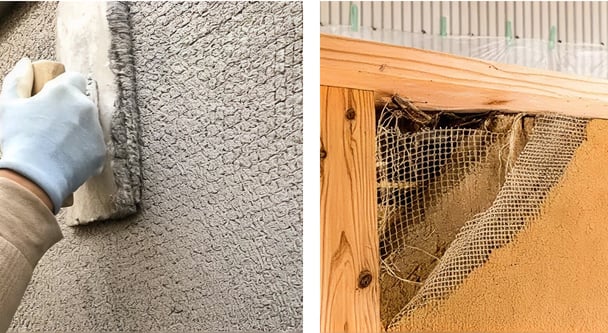
Analytical Skills
Cultural property restoration is founded on the principle of "reproduction" — thoroughly investigating and analyzing the original materials and methods, then reproducing the materials accordingly.
But a question remains: if a faithfully reproduced material ends up needing restoration again within a few years due to the site's environment or substrate, was that reproduction truly correct? To preserve a structure for future generations, the material we reproduce is sometimes not identical to the original.
That's why we also analyze site-specific conditions — such as high salt content in substrates near the sea — and reproduce materials suited to those conditions. While off-the-shelf products are sometimes used, our standard approach is on-site investigation followed by laboratory analysis of collected samples, before preparing the restoration materials.
We believe this thorough analytical capability is a strength unmatched elsewhere in the industry.
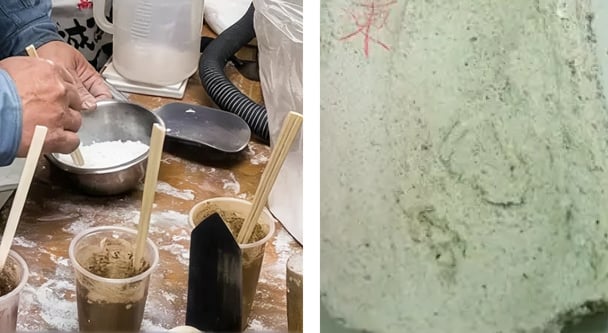
Fidelity
Just as with anything else, "shikkui" varies in quality. Shikkui made using the traditional "shio-yaki" (salt-firing) method in an earthen kiln has a notably higher degree of whiteness than industrial lime and is far less prone to cracking. On top of this, skilled craftsmen hand-inspect every batch of fired lime, using only material that passes inspection as lime for shikkui — reflecting the meticulous care and high quality we take pride in when producing lime for shikkui.
Shikkui also depends on an essential "nori" (adhesive/binding agent), particularly "taki-nori" (cooked binder), which is one of the indispensable materials in cultural property restoration. This binding agent was once cooked directly on-site, but doing so is no longer possible today due to fire-safety regulations and odor concerns. The taki-nori we produce at our factory faithfully reproduces this traditional on-site production method, and both its quality and manufacturing process have been recognized by the Association for Conservation Techniques of Cultural Property Buildings, a public interest incorporated foundation operating under the jurisdiction of Japan's Agency for Cultural Affairs.
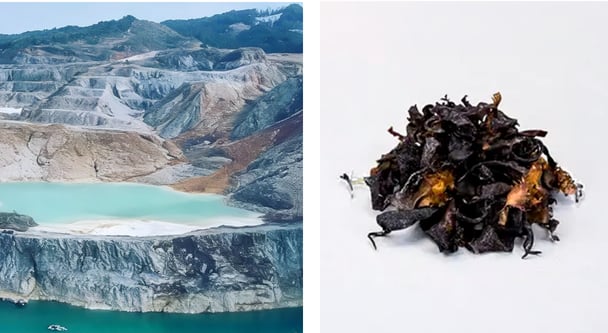
Adaptability
We handle not only shikkui as a finishing material, but also specialized materials used at the substrate (base-coat) stage. We believe that reproducing not just the visible surface, but also the parts that aren't visible, is essential for improving durability and preserving structures for future generations.
In particular, the crack-prevention netting embedded in the substrate is, today, almost always made of synthetic fiber — yet synthetic fiber netting is rarely, if ever, used when restoring cultural properties. Our proprietary "hemp netting" develops just the right amount of tension as it dries and shrinks, making it well-suited to the substrates used in cultural property restoration, and resulting in a wall with greater durability.
We are also able to accommodate colored shikkui materials, such as black shikkui and "nezumi" (gray) shikkui. Our "comprehensive capability" — supporting the entire restoration process as a one-stop service, from analysis to substrate work to finishing — is one of our core strengths.